
D.H. Zatula, Corresponding Member of the NAS of Ukraine – «Biotherapy. Natural Antitumor Substances»
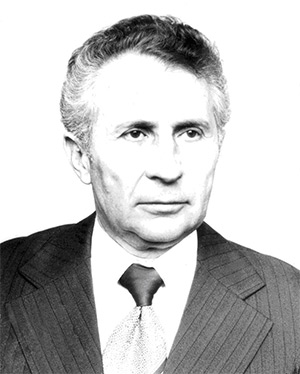
Dmytro Hryhorovych Zatula – Doctor of Biological Sciences, Professor, Corresponding Member of the Academy of Sciences of Ukraine, an outstanding national scientist in the field of oncology and microbiology, the founder of a fundamentally new direction of research aimed at creating antitumor autovaccines.
D.H. Zatula was born on February 11, 1923 on the Baba farmstead, Shevchenkove District, Kharkiv Region, into a large peasant family.
After graduating from the Shevchenkove secondary school in 1940, D.H. Zatula entered the Kharkiv Military Aviation School and in 1942, having received the specialty of transport aviation navigator, served in the active army.
Having completed training in night flying, he made many flights behind the front line and flew to the partisan units of S.A. Kovpak and O.F. Fedorov.
The unit in which D.H. Zatula served was part of a special group of special-purpose transport aircraft that carried out combat flights to the countries of Europe and the Middle East (Iran, Iraq, Syria, Palestine, Egypt, Italy, Yugoslavia). This aviation group created a reliable air bridge between the mountains of Yugoslavia and the base of the allied Anglo-American aviation in Bari (Italy). His LI-2 aircraft delivered weapons, medicines, heavy and light equipment and airborne units, evacuated wounded partisans, and transported the command staff of Greek and Yugoslav partisan detachments. More than 270 combat flights were made.
D.H. Zatula met the spring of 1945 in the Balkans, and Victory Day – in Belgrade. After the end of the war, he performed special flights to Nuremberg during the Nuremberg Trials, as well as to Japan and China (Manchuria).
For carrying out combat missions, Dmytro Hryhorovych was awarded the Order of the Red Banner, two Orders of the Patriotic War, 2nd class, the Order of the «Partisan Star of Yugoslavia», 3rd class, and ten combat medals.
After the war, D.H. Zatula was demobilized from the army and entered the Faculty of Biology of Kharkiv State University. Dmytro Hryhorovych was a diligent and persistent student and paid special attention to laboratory classes, in which his talent as an experimenter and researcher was most fully revealed.
The extraordinary academic success of the 4th-year student Dmytro Zatula was noticed by the director of the Kharkiv Chemical and Pharmaceutical Institute, M.A. Anharska. With her assistance, he was hired by the institute as a researcher, which supported him financially and revealed his talent as a scientist.
The second person who played a decisive role in his fate was M.P. Mazurenko, a prominent specialist in the field of virology. After graduating from the university, D.H. Zatula was invited by M.P. Mazurenko to the Laboratory of Cancer Biotherapy of the Kharkiv Roentgen-Radiological and Oncological Institute of the Ministry of Health of the Ukrainian SSR. From 1953, this laboratory became part of the Kyiv Research Institute of Epidemiology, Microbiology and Parasitology of the Ministry of Health of the Ukrainian SSR.
In the Laboratory of Cancer Biotherapy, D.H. Zatula studied the effect of substances of microbial origin on cancer cells and planned to defend his candidate dissertation. For long hours, Dmytro Hryhorovych observed under the microscope how cancer cells died under the action of substances formed under certain conditions by harmless bacteria widespread in nature (hay and potato bacilli).
However, in the course of this research it turned out that the microbial substances indiscriminately killed both cancer and healthy cells. This was established in experiments on animals and confirmed by many impeccable experiments. Therefore, D.H. Zatula left this direction of research for a while, moving to the radioisotope laboratory, where he began work on a dissertation on a different topic. In 1962, D.H. Zatula defended his dissertation on the topic «Experimental Study of the Combined Action of Colimycin and Ethazole on Escherichia coli of Pathogenic Serotypes».
Soon Dmytro Hryhorovych returned to the study of the antitumor activity of microbial substances. The question of treating malignant tumors with the help of microorganisms gave him no rest. Dmytro Hryhorovych set himself the goal of finding microbes that would selectively kill only cancer cells.
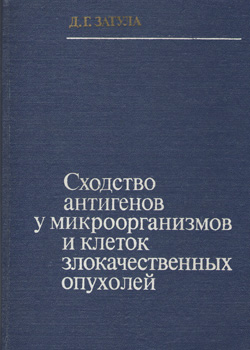
First he discovered the bacterial strain Bacillus megaterium N, but these bacteria produced substances with the opposite effect ― they accelerated the development of tumors in experimental animals. Thus D.H. Zatula laid the foundations of a problem new to science: the presence of common antigens in microorganisms and malignant tumor tissues.
D.H. Zatula paid great attention to the problem of the similarity of microbial and tumor antigens. He studied the immunochemical properties of the surface-localized antigens of B. megaterium N, their antigenic specificity, immunosuppressive activity, and effect on chemical and viral carcinogenesis and on the growth and development of spontaneous tumors in experimental animals.
It was established that bacterial cell walls have antigenic determinants similar to those in tumor cells and are capable of inducing antitumor immune reactions.In further studies, using the strain Bacillus megaterium N, a culture antagonistic to these bacteria was isolated, which was indeed able to destroy tumor cells. This culture was named Bacillus mesentericus AB-56. It was established that the culture fluid obtained after growing this bacterium on a nutrient medium had a destructive effect on cancer cells. Such cells lost their viability but retained high immunogenicity. Three-time administration to experimental animals of cancer cells treated with the culture fluid filtrate led to the development in these animals of 60-100% insusceptibility (resistance) to subsequent tumor transplantation. These data became the basis for the development of antitumor vaccines.
Dmytro Hryhorovych carried out these studies from 1962 to 1968 at the Kyiv Research Institute of Epidemiology, Microbiology and Parasitology of the Ministry of Health of the Ukrainian SSR, working first as a Junior and then as a Senior Researcher. At the same time, from 1963 he worked as an instructor and consultant of the Department of Science and Educational Institutions of the Central Committee of the Communist Party of Ukraine.
On November 20, 1968, D.H. Zatula was elected by competition Head of the Department of Natural Antitumor Substances established at the D.K. Zabolotny Institute of Microbiology and Virology of the Academy of Sciences of the Ukrainian SSR (IMV of the AS of the Ukrainian SSR). Here he continued his research on the topic «Antigenic Similarity of B. megaterium N to Cells of Malignant Neoplasms and the Use of This Phenomenon in Tumor Immunology», and on January 29, 1971 defended his dissertation for the degree of Doctor of Biological Sciences.
Despite his extraordinary workload as an administrator, he paid considerable attention to the creation of an antitumor autovaccine using B. mesentericus AB-56. The scientist dreamed of establishing the production of an active antitumor preparation based on this microorganism, and studied the modes of its cultivation, the nutrient media that would ensure the maximum yield of the active substance, and the methods of its purification and storage.From 1970, D.H. Zatula worked as Deputy Director for Science, and from September 30, 1971 as Acting Director of the IMV of the AS of the Ukrainian SSR. From March 14, 1973 to March 14, 1977, Dmytro Hryhorovych worked at the IMV of the AS of the Ukrainian SSR as Director of the institute.
On December 27, 1973, D.H. Zatula was elected a Corresponding Member of the Academy of Sciences of the Ukrainian SSR, and on April 1, 1977 he, together with the Department of Natural Antitumor Substances, was transferred to the Institute of Oncology Problems of the Academy of Sciences of the Ukrainian SSR (now the R. E. Kavetsky Institute of Experimental Pathology, Oncology and Radiobiology of the NAS of Ukraine), where he worked until the end of his life.
While working at the Institute of Oncology Problems of the Academy of Sciences of the Ukrainian SSR, D.H. Zatula made great efforts to ensure that the antitumor vaccine underwent clinical testing. By order of the Presidium of the Academic Council of the Ministry of Health of the USSR, the vaccine was tested at the Kyiv Roentgen-Radiological and Oncological Institute of the Ministry of Health of the Ukrainian SSR and at the All-Union Oncological Research Center of the Academy of Medical Sciences of the USSR (Moscow). In the treatment of patients with stage III-IV gastric cancer, it was proven that postoperative immunization of cancer patients with an antitumor vaccine made from the patient’s autologous tumor tissue and the metabolic products of B. mesentericus AB-56 led to a statistically significant increase in their survival compared with patients who received only surgical treatment or surgical treatment combined with chemotherapy.
Later, studies were conducted on the effectiveness of antitumor autovaccines in the treatment of patients with cancer of the lung and intestine, brain glioblastoma, etc. Clinical testing of the autovaccines, as well as their preclinical studies in animal experiments, showed the absence of any side effects. The developed vaccine has many advantages over similar analogues in other countries ― in terms of manufacturing technology, as well as effectiveness and cost of treatment. Today, scientists of the R.E. Kavetsky Institute of Experimental Pathology, Oncology and Radiobiology of the NAS of Ukraine are improving this vaccine and developing other generations of antitumor vaccines.
The most important achievements of D.H. Zatula are his hypothesis about the presence in certain microbial cultures of antigens similar to the antigens of tumor cells, and the invention of an original method of creating an antitumor vaccine based on the products of microbial metabolism.
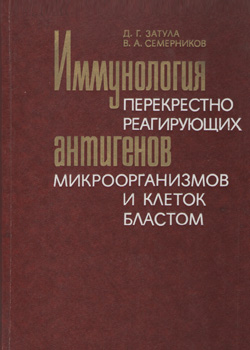
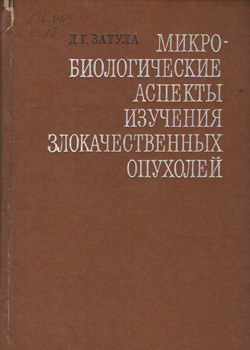
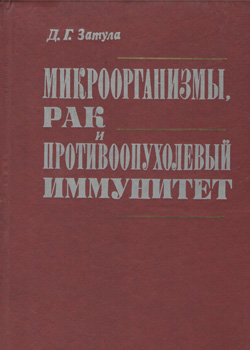
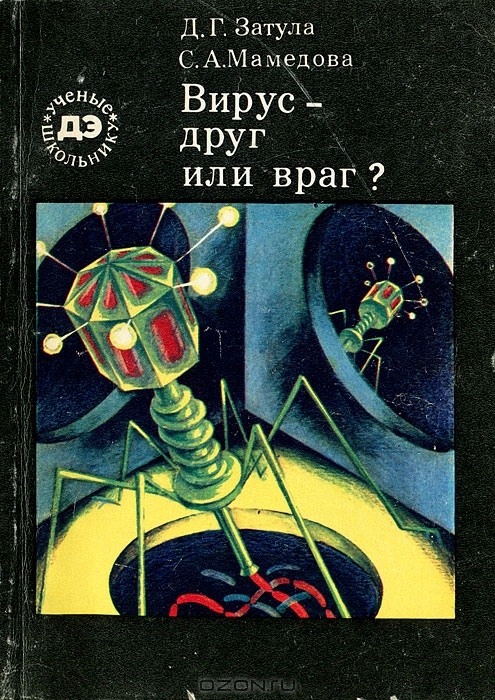
D.H. Zatula is the author of more than 200 published works, 8 monographs, 5 inventions, and popular science publications that have not lost their relevance to this day. His book «Virus – Friend or Foe?» was republished in eight languages. The fundamental studies of D.H. Zatula in the field of the regulation of antitumor immunity proved especially valuable.
Zatula D.H., Mamedova S.A. Virus – Friend or Foe? – Moscow: Pedagogika, 1981. – 128 p. (in Russian)2.5 MB
The scientific achievements of D.H. Zatula were recognized by the Academician D.K. Zabolotny Prize of the Academy of Sciences of the Ukrainian SSR and the Order of Friendship of Peoples. He was always full of new ideas, many of which remained unrealized. He experimented a lot and was always interested in new achievements of science.
Dmytro Hryhorovych Zatula died on June 9, 1987 and was buried in Kyiv at Baikove Cemetery.