


Antitumor Autovaccine
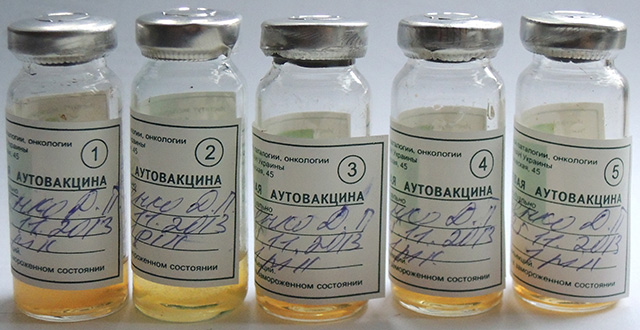
In order to enhance the therapeutic effect of classical methods of therapy of cancer patients, to ensure their complete recovery or to prevent relapses and the formation of metastases, various means of biotherapy are recommended. Antitumor autovaccines (AAV) are particularly promising in this regard.
The IEPOR of the NAS of Ukraine has developed an antitumor autovaccine based on antigens from the patient’s tumor tissue, modified with cytotoxic lectins (CL) — products of synthesis of the saprophytic culture B. subtilis B-7025. This method of vaccine production ensures their high specificity and immunogenicity due to the presence of modified tumor-associated antigens and microbial adjuvants. The use of antitumor autovaccines in the complex therapy of cancer patients significantly increases their survival time for certain localizations and histological forms of malignant tumors, normalizes immunological parameters and improves the quality of life of patients.
The vaccine is indicated for patients with stage I-III cancers after surgical removal of the tumor. The use of the vaccine has no age restrictions. It is recommended as an independent means of restoring immunity after surgery, as well as for immunological correction after surgery or chemo- and radiation therapy.
The autovaccine exerts an antitumor effect, improves the tolerance of patients to chemo- and radiation therapy, and prevents the development of cytopenic conditions. The autovaccine exhibits antirelapse and antimetastatic action in various nosological forms of malignant neoplasms. It is also indicated for functional immunodeficiencies and suppression of the phagocytic and cytolytic functions of immunity. The antitumor autovaccine is used as prescribed and under the supervision of a physician.
AAV is used in the postoperative period to prevent relapses and metastases by increasing the body’s antitumor resistance, to prolong the duration and improve the quality of life of cancer patients. The course of autoimmunotherapy (depending on the patient’s condition and the need for other therapy) consists of 3 injections at an interval of 7 days and subsequent revaccination 1 and 6 months after the last vaccination. Depending on the patient’s condition and the need for other therapy, vaccination begins 10-14 days after surgery or on days 18-21 after completion of chemo- or radiation therapy. The vaccine is prescribed only for subcutaneous injections.
Gastric cancer. The use of the antitumor autovaccine as part of the complex therapy of patients with gastric cancer increases patient survival even in the presence of metastases (T3-4N1-3M0).
Lung cancer. In patients with lung cancer, the antitumor autovaccine increases survival rates both in squamous cell lung cancer and in other forms, normalizes immunological parameters and improves the quality of life of patients.
Colorectal cancer. In the complex treatment of patients with colorectal cancer, the use of the antitumor autovaccine improves the 5-year survival rates of patients. At the stage of the tumor process T3-4N0M0 in vaccinated patients with colon adenocarcinoma, compared with patients who underwent only surgical treatment, overall survival was 88.37 and 74.44%, and relapse-free survival — 79.67 and 63.91%, respectively.
Breast cancer. The antitumor autovaccine in the regimen of complex treatment of patients with breast cancer increased the 5-year survival rates of patients, improved immunological parameters and improved their quality of life.
Thus, immunotherapy using the autovaccine ensures the formation of a specific immune response against the given tumor, normalizes immunological parameters, prolongs the survival time of patients and improves their quality of life.
Inquiry about the antitumor autovaccine
Page of the laboratory that developed the autovaccine: Laboratory of Oncoimmunology and Antitumor Vaccines Engineering
For information on the antitumor vaccine, please also call:
+38 (044) 259-91-94
+38 (068) 357-17-65
+38 (050) 469-63-00
The IEPOR of the NAS of Ukraine is a research institute that studies fundamental issues in the field of oncology and develops effective methods for early and differential diagnosis of cancer, prognosis of the course of the disease and determination of sensitivity to drug therapy. The Institute does not have its own clinical base and does not engage in medical practice.